
Command
It carries a frame number.
Defence and resilience
Jamming and congested networks turn delay into a tactical problem. The operator must know when the image stopped being valid.
Needs: Two networks at onceResilience in outagesIntegration into your own drone
Illustrative case study
This is not a customer and not a flight that happened. It is a description of how this area would read if the image carried its age.
A training ground, an illustration
A unit trains control beyond line of sight. Every command is to carry the number of the frame it came from. After the exercise they ask how many commands rested on an old image.
In the example one network fails. The frame goes via the other. When neither is valid, Direct shows a neutral screen. A late command is not executed.
Operators rotate. The record says who saw which frame. This is not a weapon system and not resistance to every kind of jamming.
It carries a frame number.
A neutral screen, not a frozen scene.
The share of commands from an old image is visible.
A radio backup is not yet in the design.
The chart requires JavaScript.
The chart is a simulation. Move the slowdown and see when the example stops being under the 50 ms target. The target is not a measured result.
Deployment schematic
The schematic is not to scale and is not a design for a specific site. It shows where the drone is, which two networks carry the frame and where the decision is made.
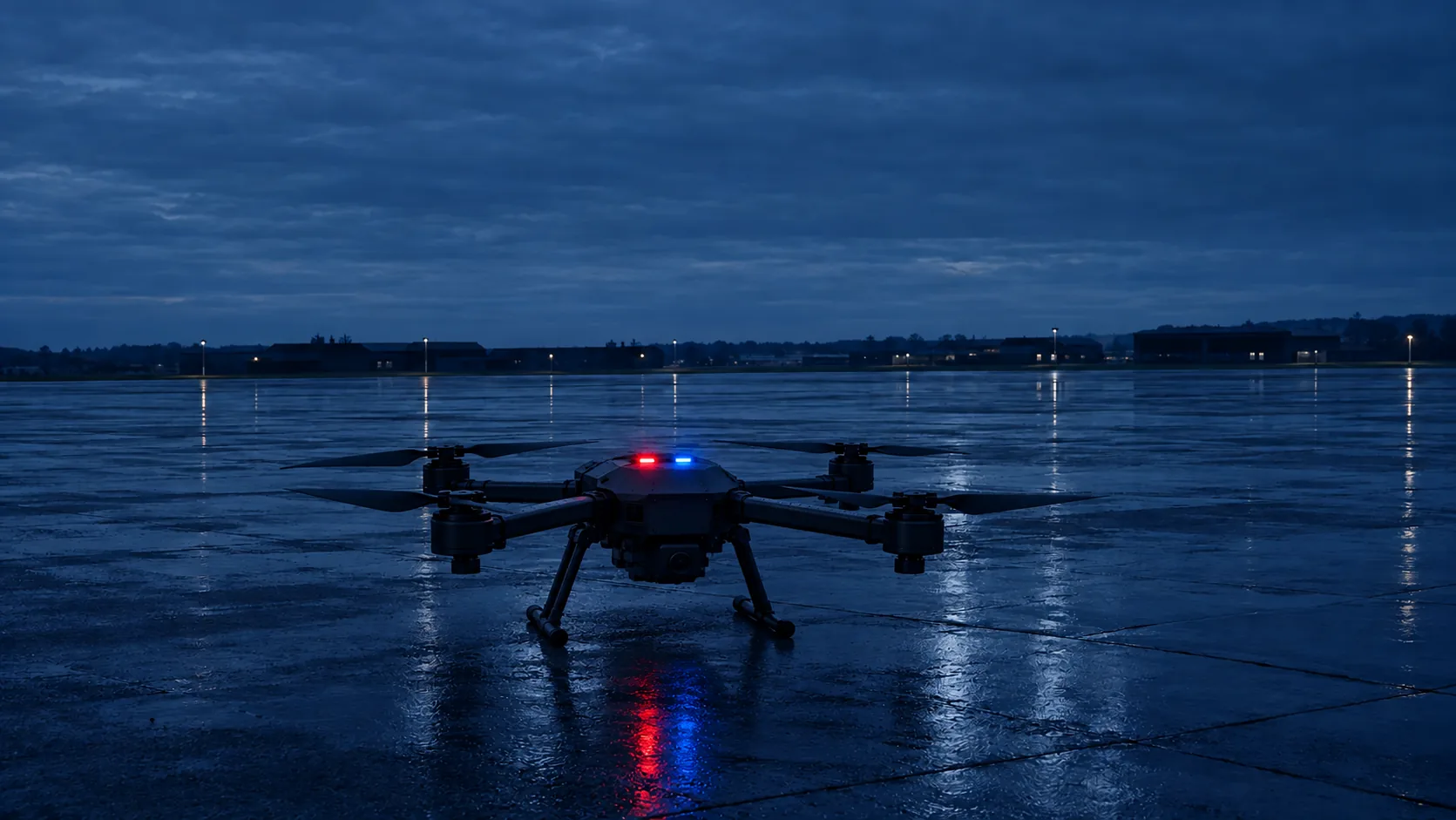
Red and blue beacons: police, state, the military in training. Orange: everyone else. The blink is only on screen. Schematic, design. The list beside it explains the codes in the drawing. The beacon is a payload from another maker, not an AKIZU product.
Concrete case
The same illustrative case as above, written out in time. The times are an example. It is not a record of a flight that happened.
An illustration, not a deployment record. N
Use options
Each row is a separate use. The Parts column says which AKIZU parts it would involve. Status N is a design, C is a target, U is unknown.
| Use | Who uses it | What AKIZU supplies | Parts | Status |
|---|---|---|---|---|
| Beyond-line-of-sight control training | Training centre | A command with a frame number and a debrief | Brain, SIM, Direct, Platform | N |
| Terrain reconnaissance in an exercise | Unit | Image age on every command | Brain, Direct | N |
| Operator rotation | Exercise commander | A record of who saw which frame | Platform | N |
| A network-loss drill | Training | A visible state, not a frozen scene | Direct | N |
| Radio backup | — | Not yet in the design | — | U |
None of these uses is deployed today. A row is not an offer and not an authorisation to fly.
01
The link changes from second to second. An image that freezes without warning is dangerous.
If the operator reacts to an old image, the drone executes the command in a different situation than the one the operator saw.
In sensitive deployments it matters where the software comes from and where the data is.
If operators rotate, the record must say who saw which frame.
The same situation, different information on the screen. Proposed behaviour, to be verified in a pilot.
| Situation | Without AKIZU | With AKIZU |
|---|---|---|
| The image is late | The image looks live; the pilot does not know how old it is. | Frame age is on the screen and the state changes to Reduced freshness. N |
| One network fails | The image freezes or breaks up. | The frame arrives over the second network; the switch is logged. N |
| Link outage | The last frame stays on screen and looks valid. | A neutral screen with the reason, not a frozen image. N |
| Your own drone, your own software | Image-age measurement has to be built from scratch. | Brain and VERA as a module with a clear interface. N |
02
The flow is illustrative. AKIZU is in development.
03
How many metres further the drone is than the image shows. Pick a scenario or set the speed and image age.
The interactive calculation requires JavaScript.
Scenario speeds are examples. 87.4 ms is the p99 measured internally over WiFi with a phone as transmitter, not on a drone.
04
| Requirement | How AKIZU answers it | Status |
|---|---|---|
| Commands only from a valid image | Every command carries a frame number; the drone rejects late ones | N |
| Jamming and outages | Two networks and a neutral screen with the reason | N |
| Origin of software and data | European supply chain for Brain and Platform | C |
| Post-exercise debrief | Share of commands from an old image in Platform | N |
05
Knows when the image stopped being valid; their commands are not executed in a different situation.
Sees which image the decisions rested on.
Has numbers for the debrief after the exercise.
06
07
In February 2026 the European Commission published an action plan on drone and counter-drone security.
Source: European Commission
The 3GPP standard describes video requirements for controlling a drone beyond line of sight, including 140 ms.
Source: 3GPP TS 22.125
The station does not show an old frame as current. When the age exceeds the deadline it switches to a neutral screen and shows the reason. We measured the switch internally within 2.72 ms.
The target is data centres in the European Union. The customer sets the retention period for records and video.
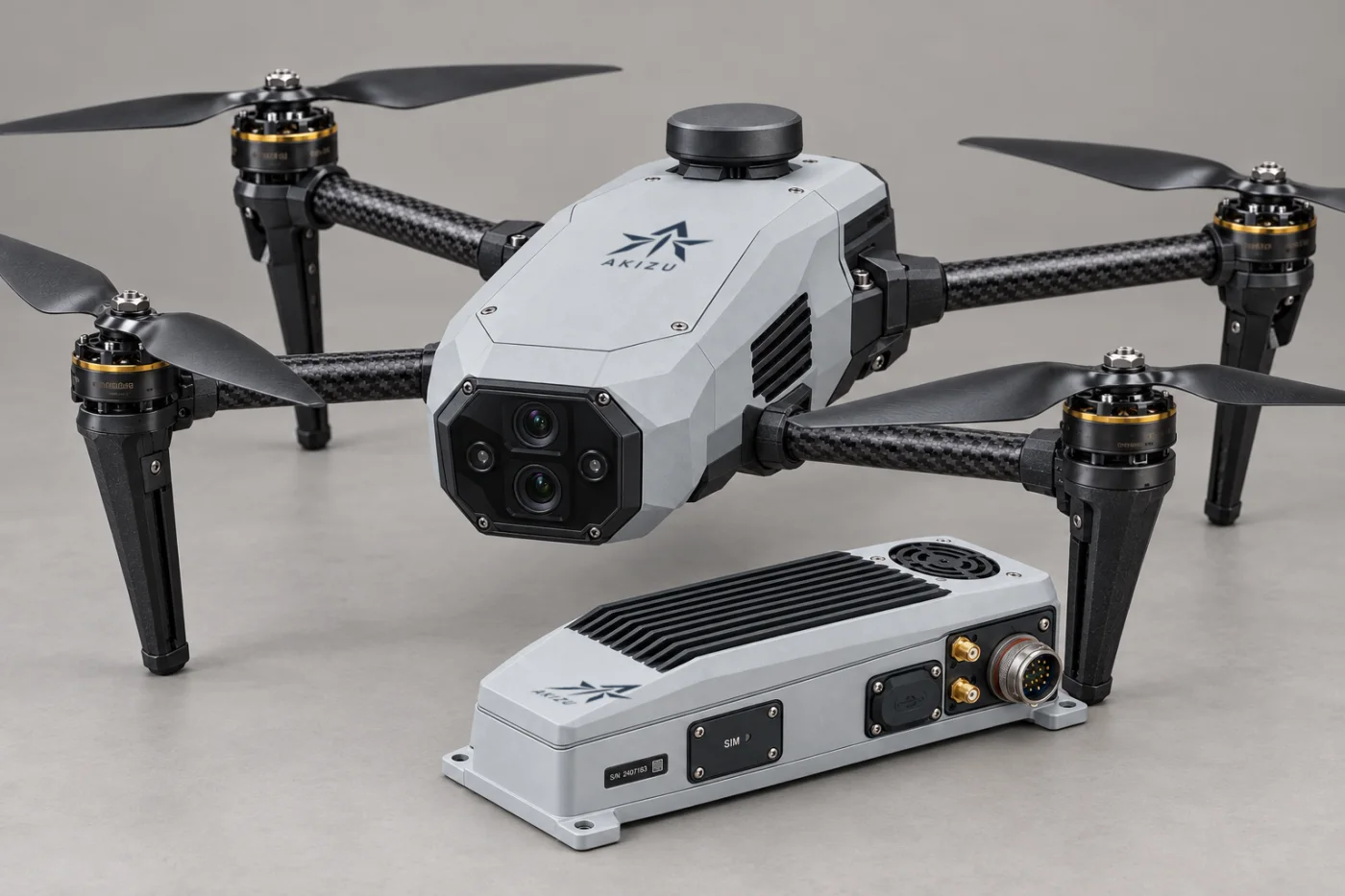
Brain will have a nano-SIM slot. We plan AKIZU SIM as an option managed in AKIZU Platform. Terms for using other cards will be agreed with partners.
09
The three image states in this area. Proposed behaviour, to be verified in a pilot.
The operator knows the command comes from a current image.
The command may still pass, but the panel says the margin is running out.
The drone does not execute a late command. The screen does not keep a frozen scene.
10
Illustrative layout. Drone and station counts are an example, not an offer.
Ahead of the unit
An image of known age, not an impression.
Second operator
When one network fails, the frame goes via the other.
Post
Sees which image the decisions rested on.
11
Times are an example. They show when image age decides.
12
AKIZU does not control weapons and does not design tactics.
Two networks are a design. A radio backup is not yet part of it.
A target for Brain and Platform, not a finished supplier audit.
A pilot in this area
We are looking for first partners. The application is pre-filled for this area.
Other areas
Example deployments are illustrative. AKIZU is in development and does not replace a BVLOS authorisation.
In more detail
Remote practice needs a frame number on the command. It is not a weapon.
We ask how many commands today rest on an image whose age you do not know. That is a debrief question, not a question of armament.
We do not promise resistance to every kind of jamming. A radio backup is not in the design.
Explore
Twelve solution areas and the sections that belong with them. The case studies are illustrations, not completed deployments.