
EN
Book a demo
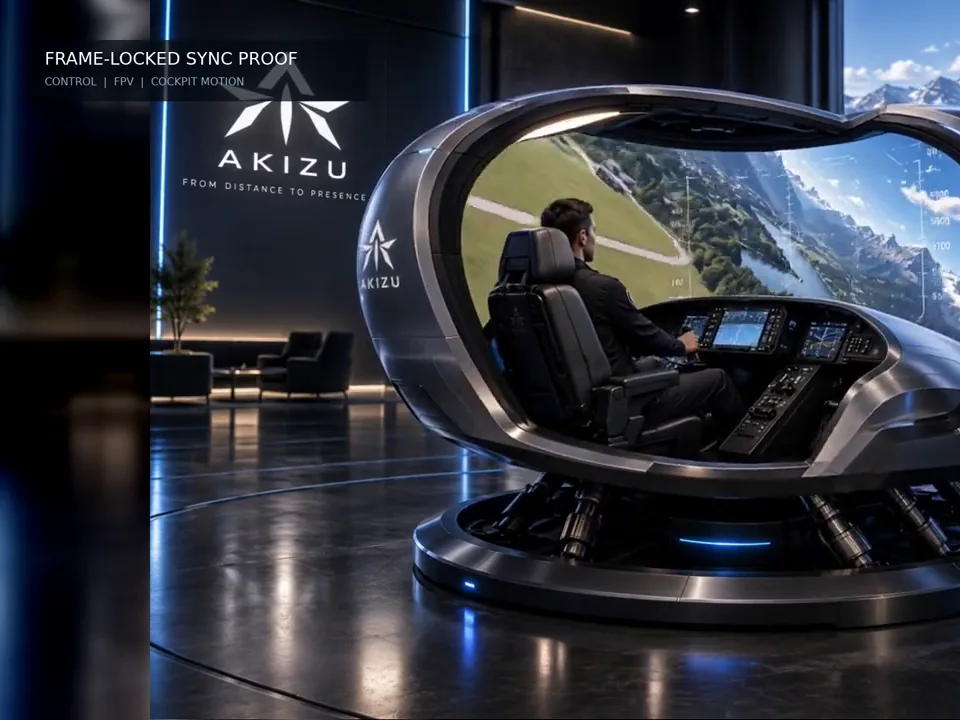
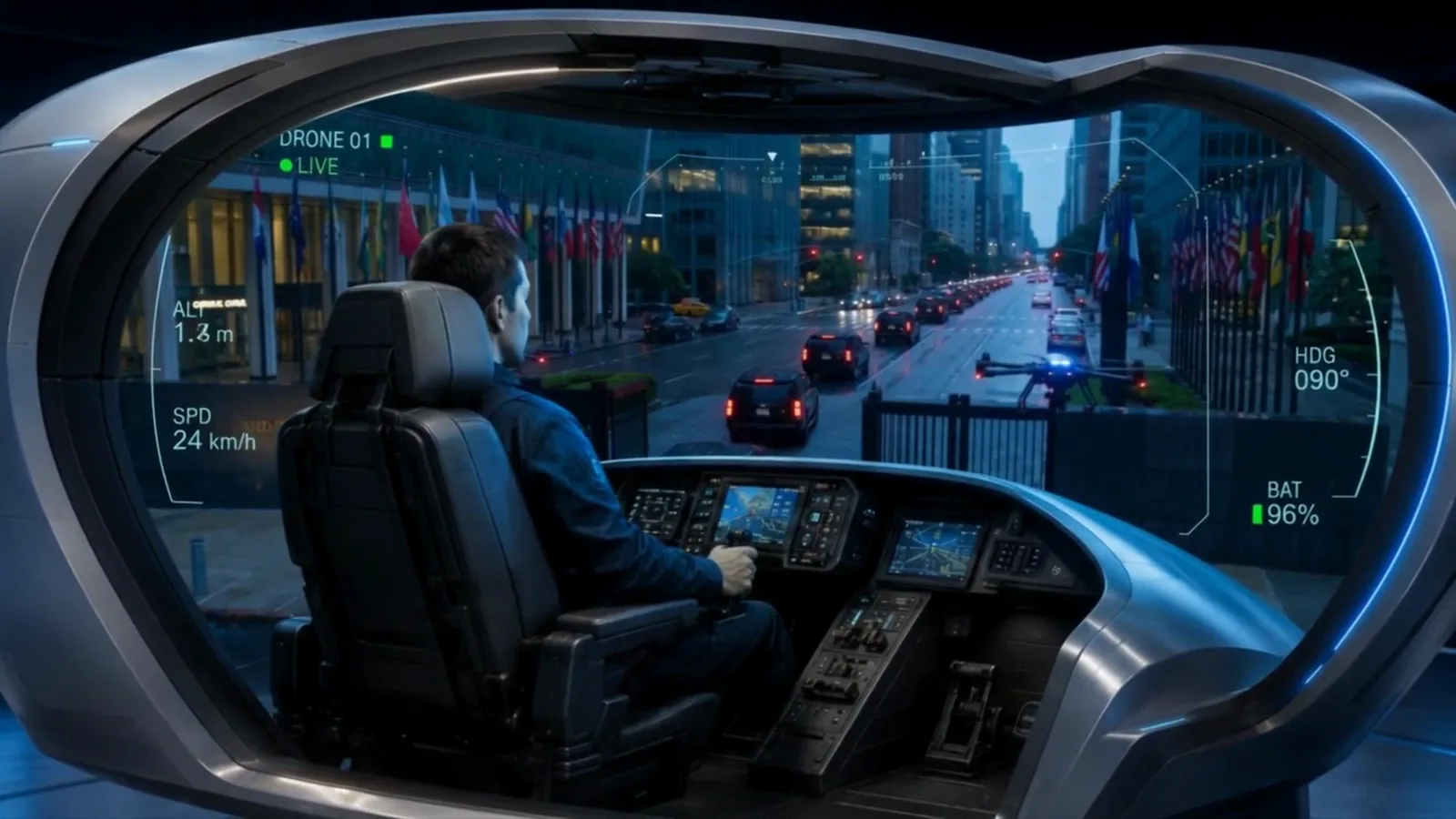
Operator in the AKIZU Direct cockpit, visualisation

Remote presence

Remote by distance.
Present by design.

Drone, onboard unit, SIM cards, platform and cockpit in one system. The remote operator sees the image and knows its age. If the system cannot guarantee this, it does not pretend the image is live.

From distance to presence Visualisation

Solution

One chain from camera to operator’s eyes

Every link in AKIZU is designed to avoid losing time or concealing faults. Video travels from the drone via the onboard unit and mobile networks to the platform and cockpit. Information about its age travels with it.

The entire chain is governed by the VERA protocol: each frame carries its exposure time and validity deadline.

Products

Five components. Together or individually.

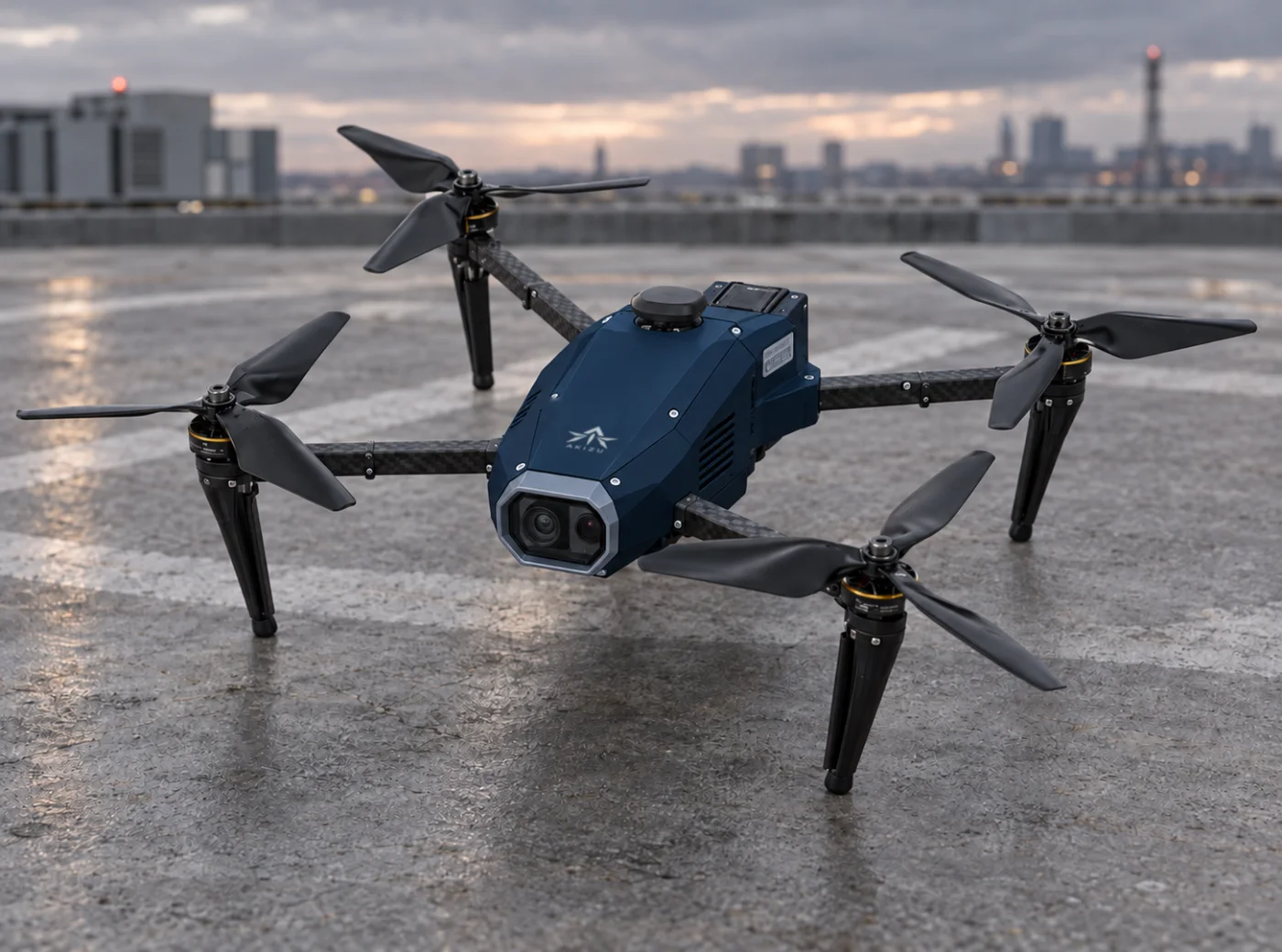
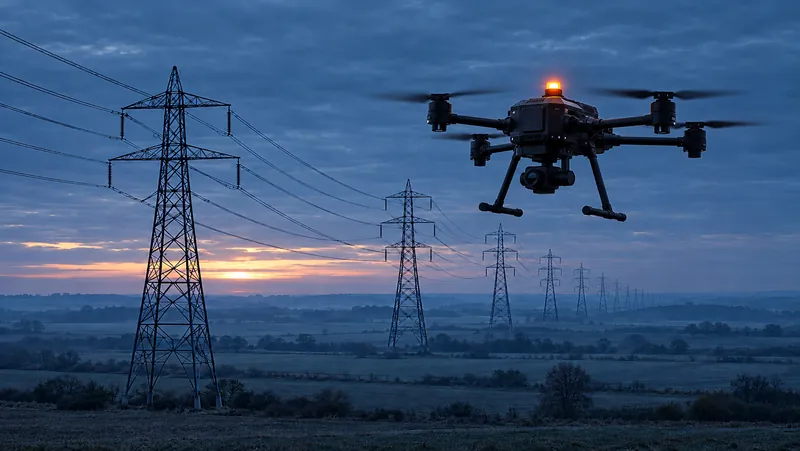
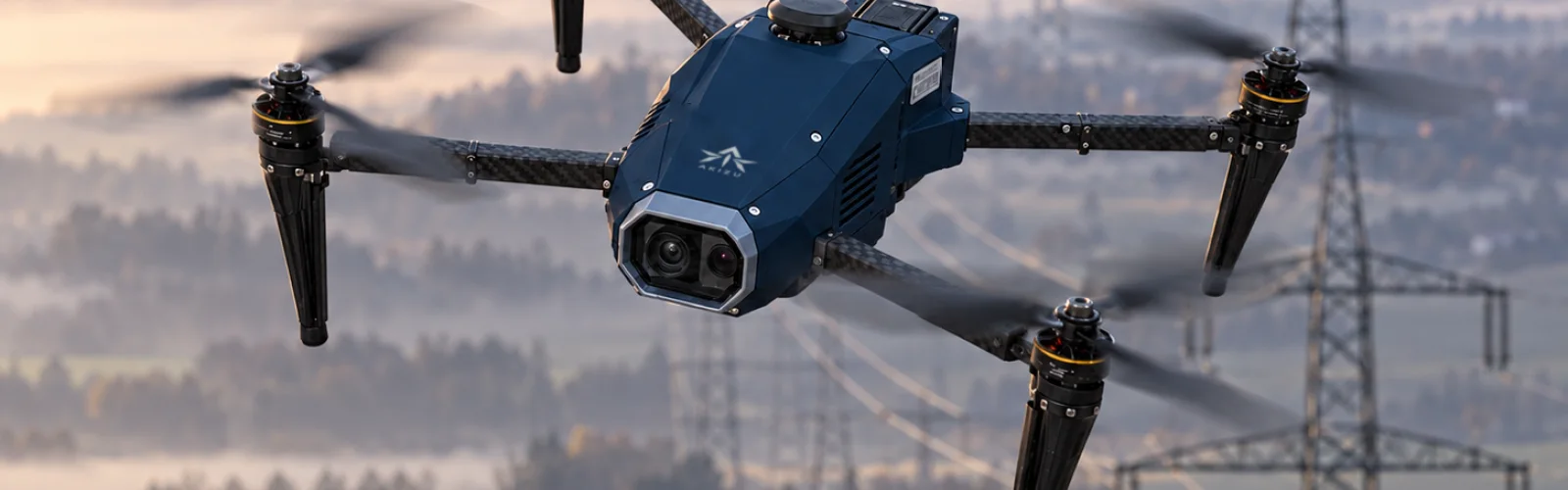
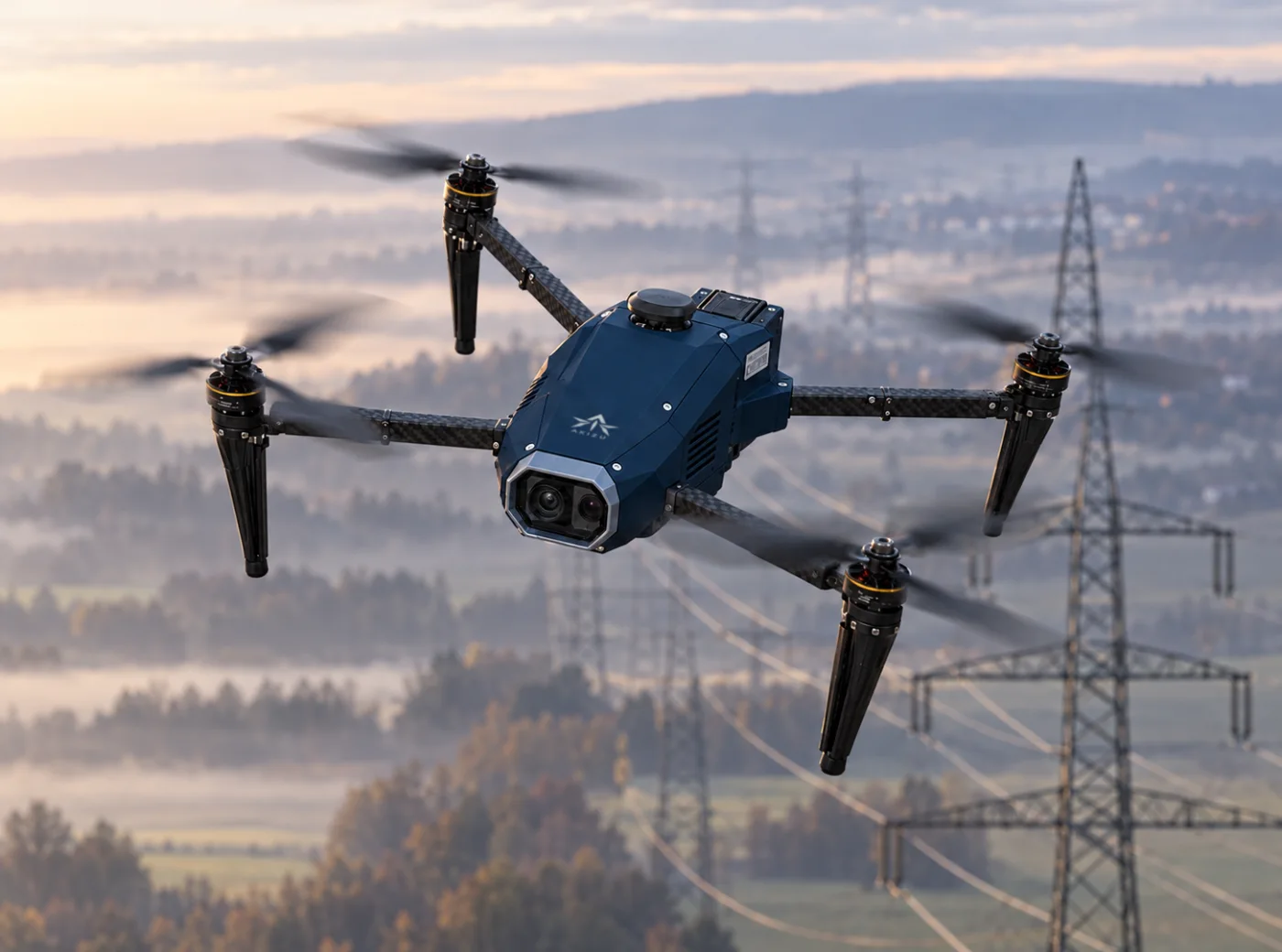
AKIZU Drone with a dark blue fuselage above a high-voltage power corridor
Visualisation

01 / Drone

In the air.

A drone designed for beyond-visual-line-of-sight flights over mobile networks. The camera, onboard unit and antennas are designed as one integrated system from the outset, rather than as an add-on fitted to a third-party aircraft.

  • Reference configurationModalAI Starling 2 Max, VOXL 2
  • CameraUp to 240 frames/s
  • StatusIn development
More about: AKIZU Drone →

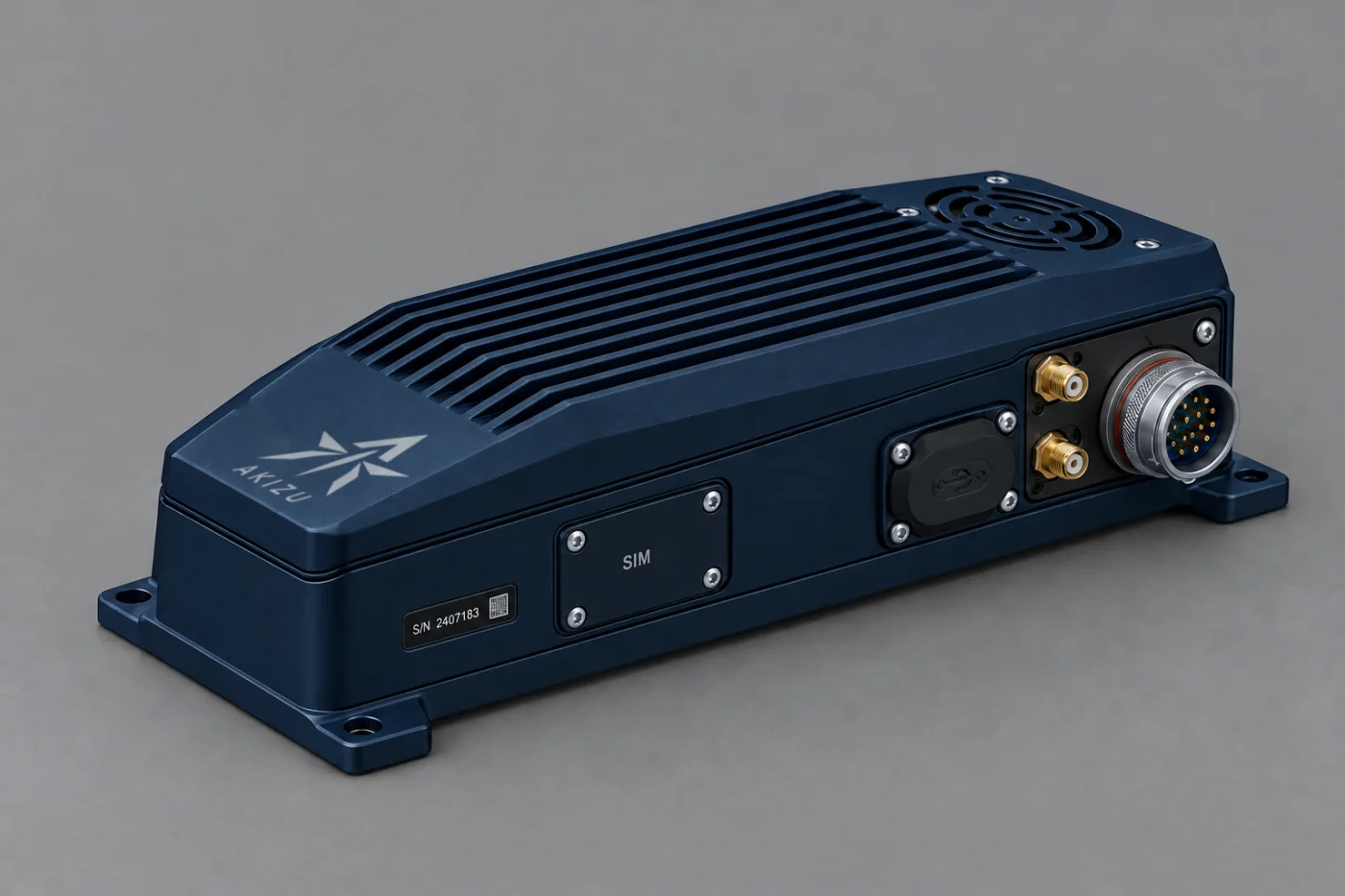
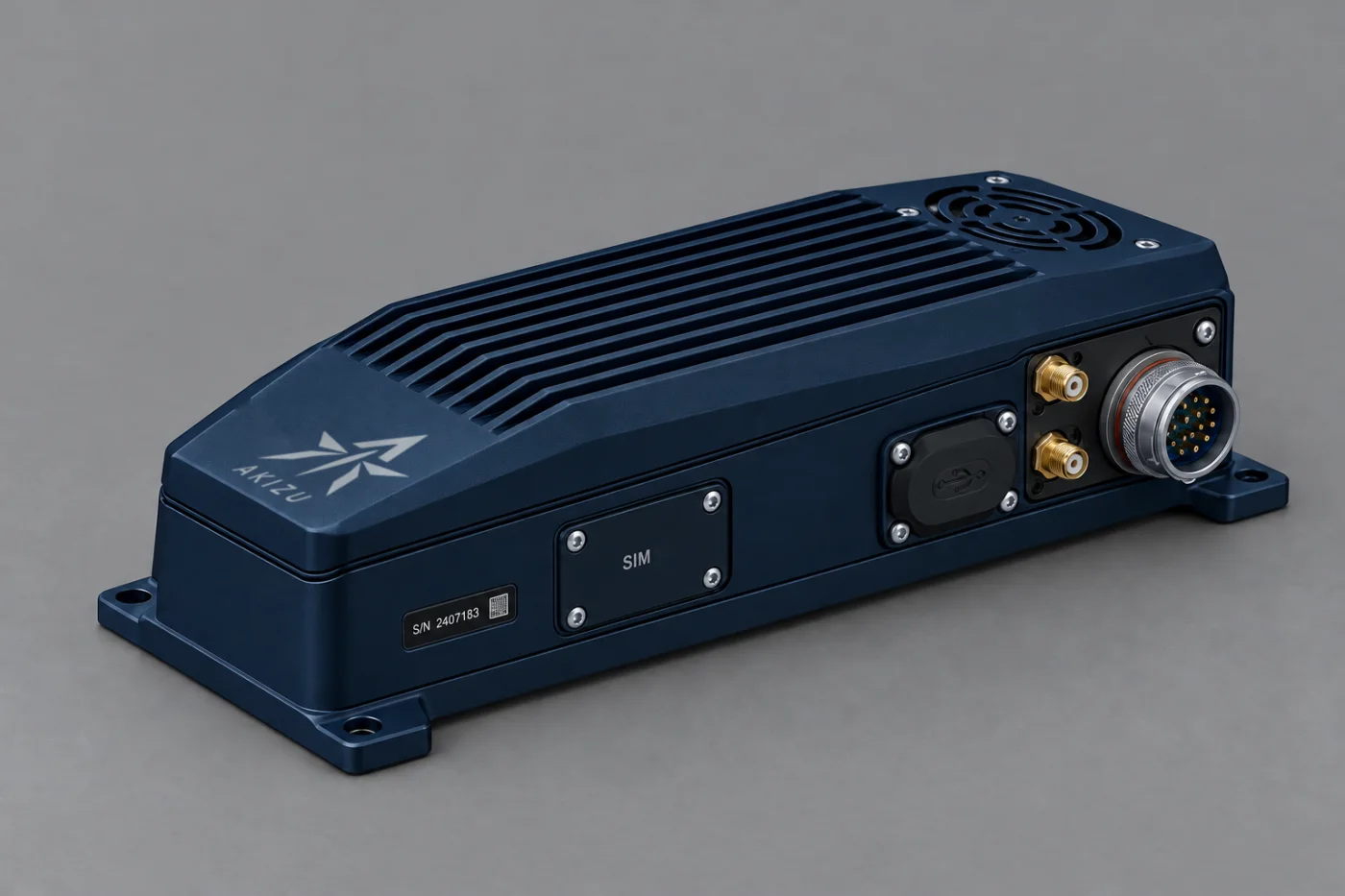
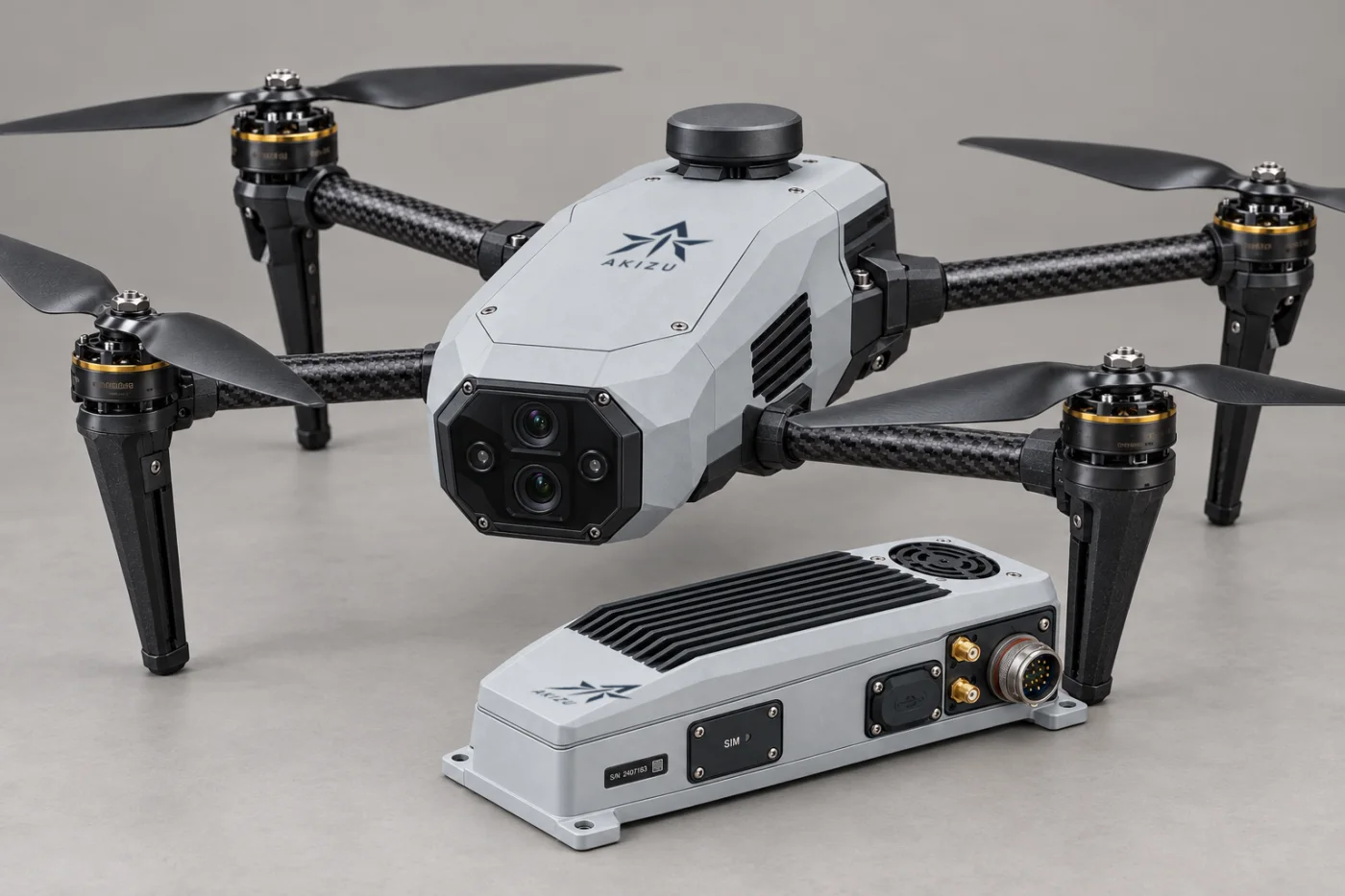
AKIZU Brain onboard unit in a dark blue aluminium enclosure
Visualisation

02 / Brain

At the edge of the network.

An onboard unit that turns images into evidence. It encodes video, attaches the exposure time to each frame, sends it over the mobile network and discards anything that arrives too late. It also records the flight black box.

  • FunctionsEncoding, VERA, 5G, black box; Duo with two modems as a concept
  • InstallationAKIZU drones; other platforms after validation
  • StatusIn development
More about: AKIZU Brain →

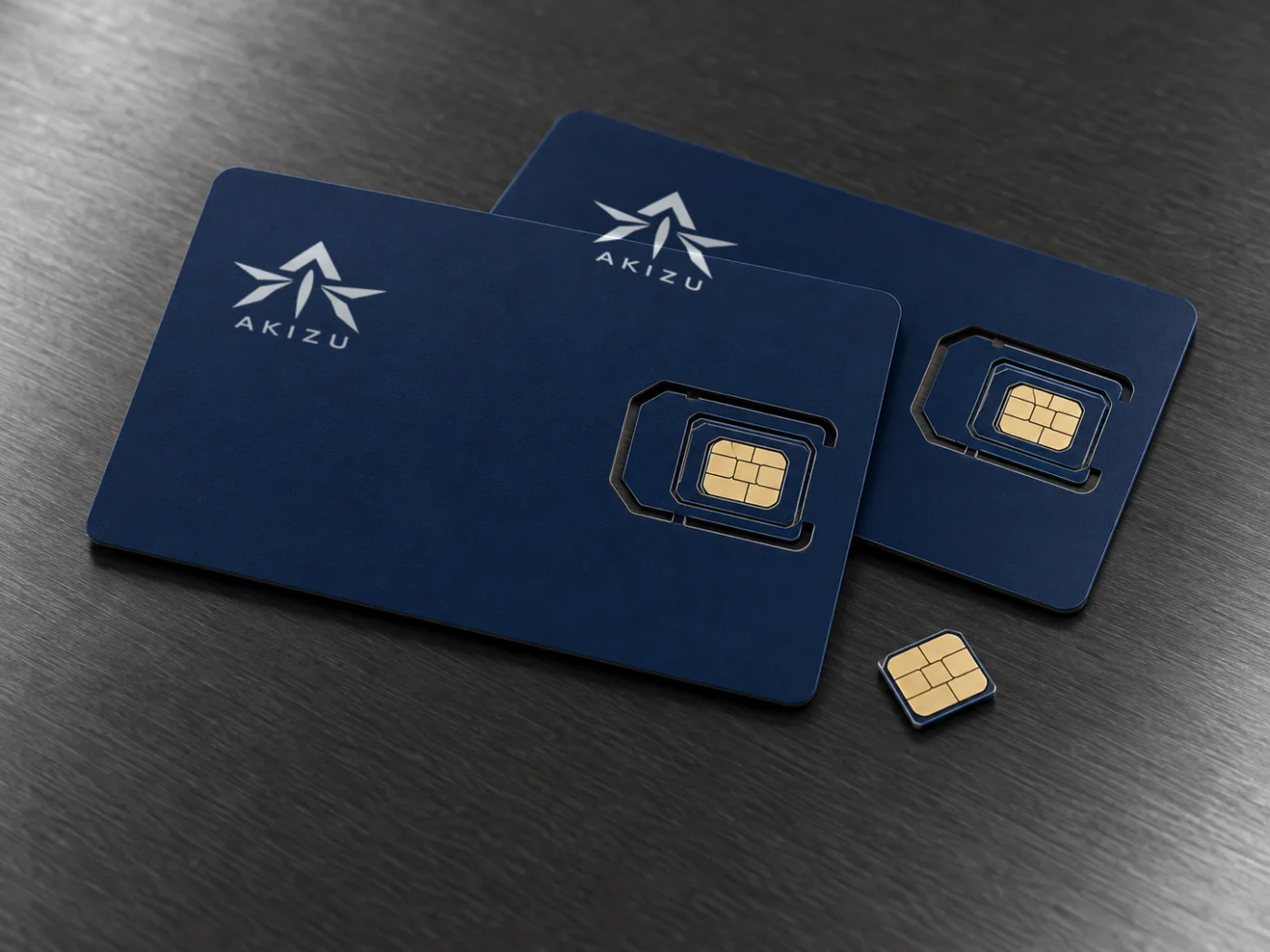
AKIZU data SIM cards with logo
Visualisation

03 / SIM

On two networks at once.

Data SIM cards for drones. With the Brain Duo concept, they will connect through two operators simultaneously, so an outage on one cell will not mean losing the video feed. Manage cards, data and connection status in the platform.

  • ConnectionLTE and 5G, two operators simultaneously
  • ManagementIn AKIZU Platform
  • StatusIn preparation

More about: AKIZU SIM →

Hardware design

Designed as a working tool

Drone and Brain in two colourways. Milled aluminium, matte composite, visible screws and seals. Choose a colour to view both products.

AKIZU drone on a roof
Drone · visualisation
AKIZU Brain
Brain · visualisation
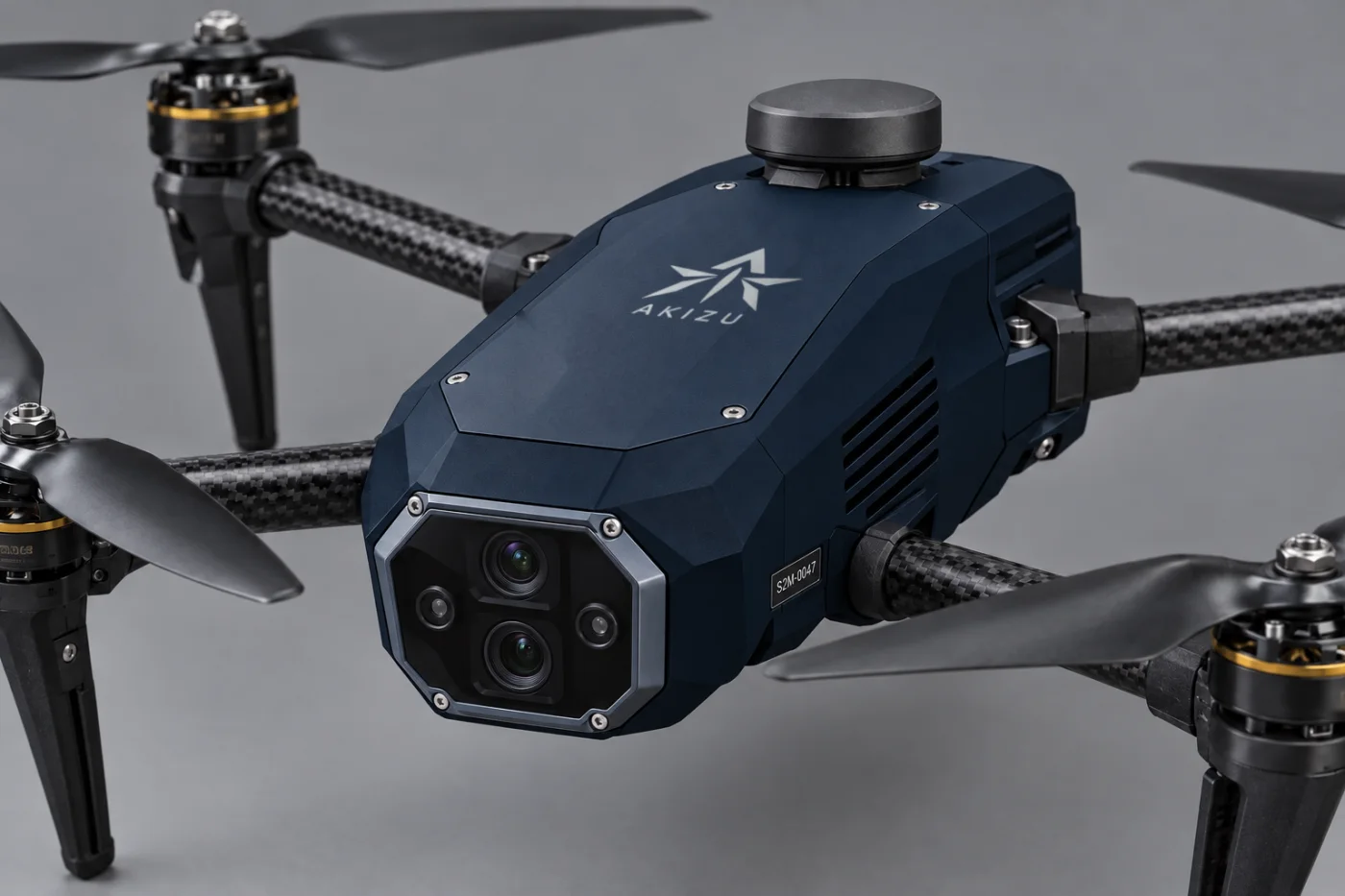
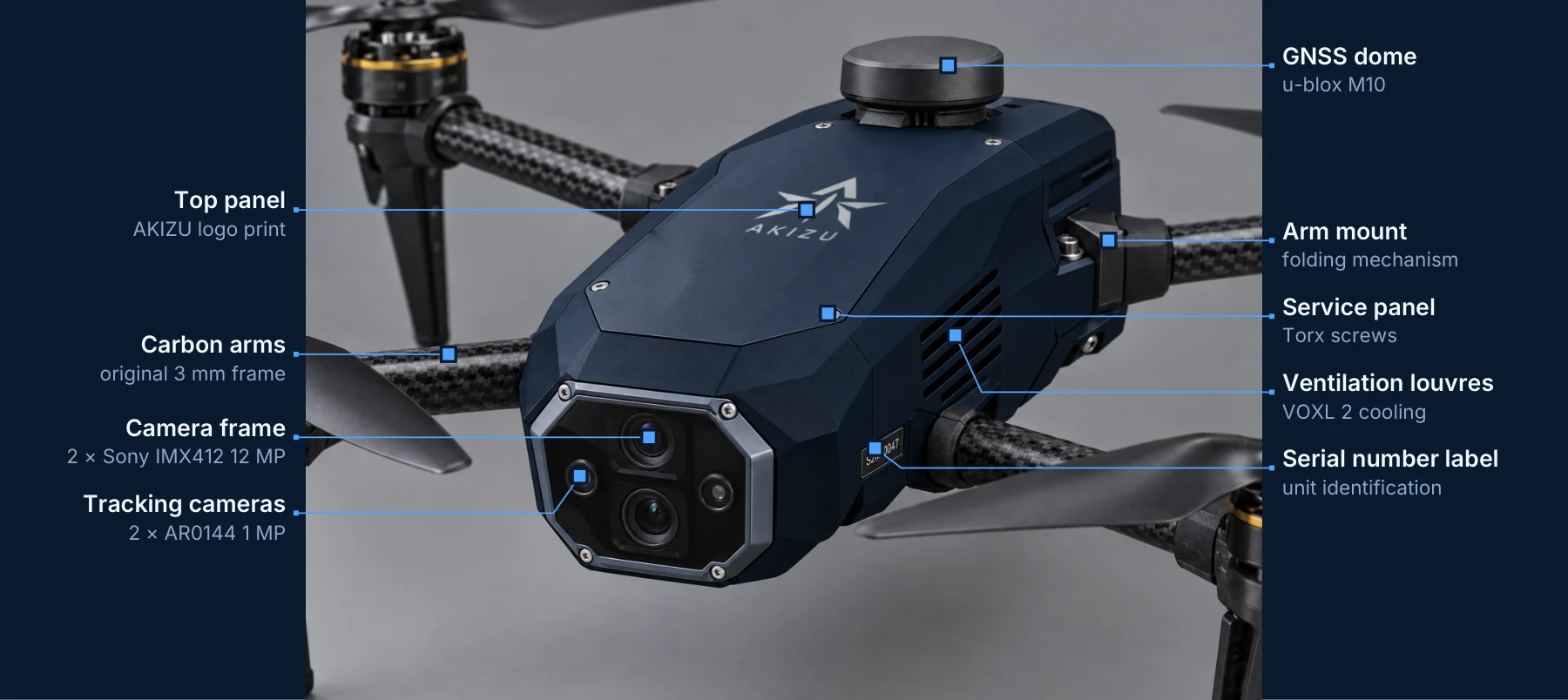
AKIZU drone fuselage detail
Fuselage · visualisation
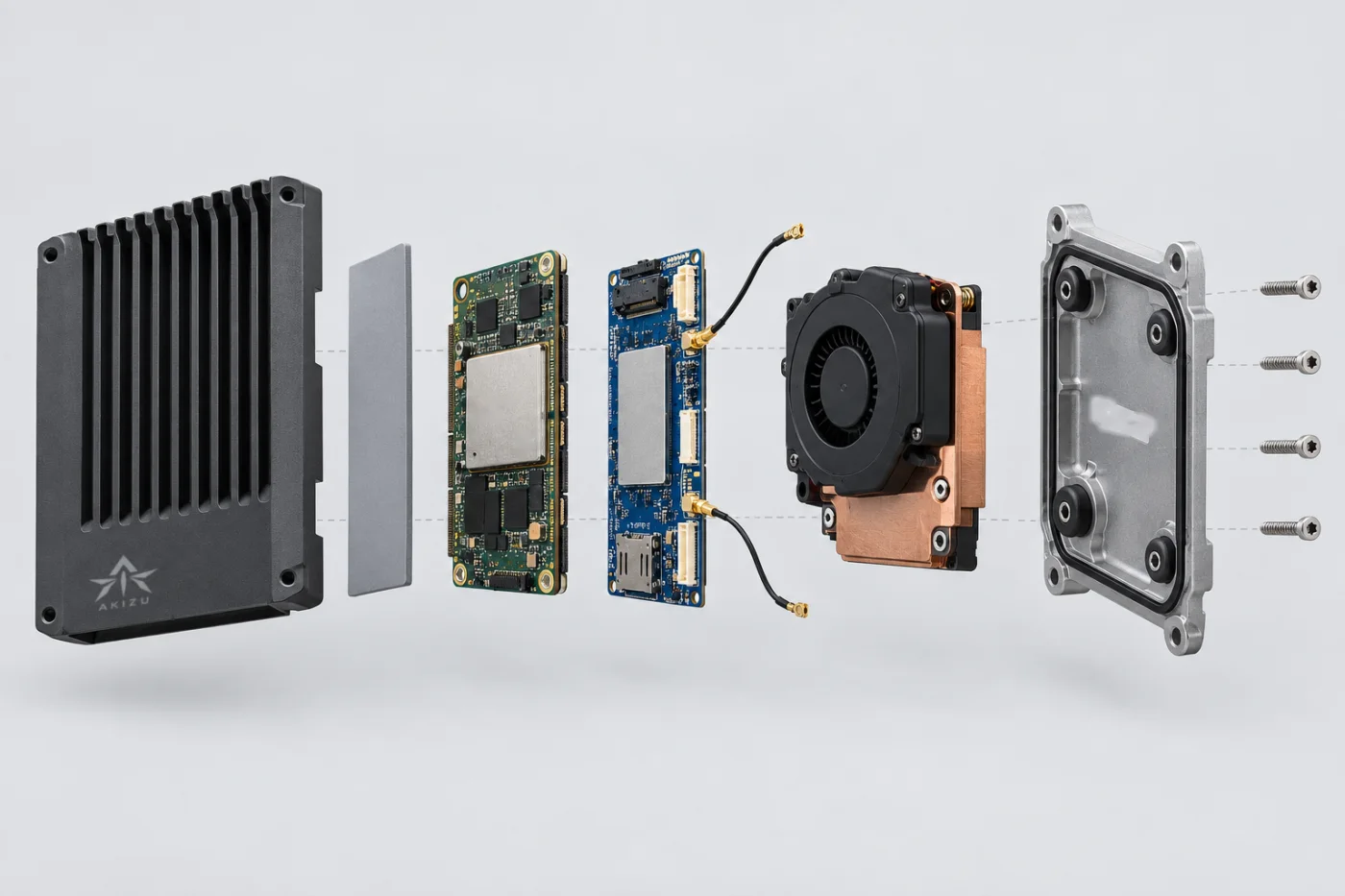
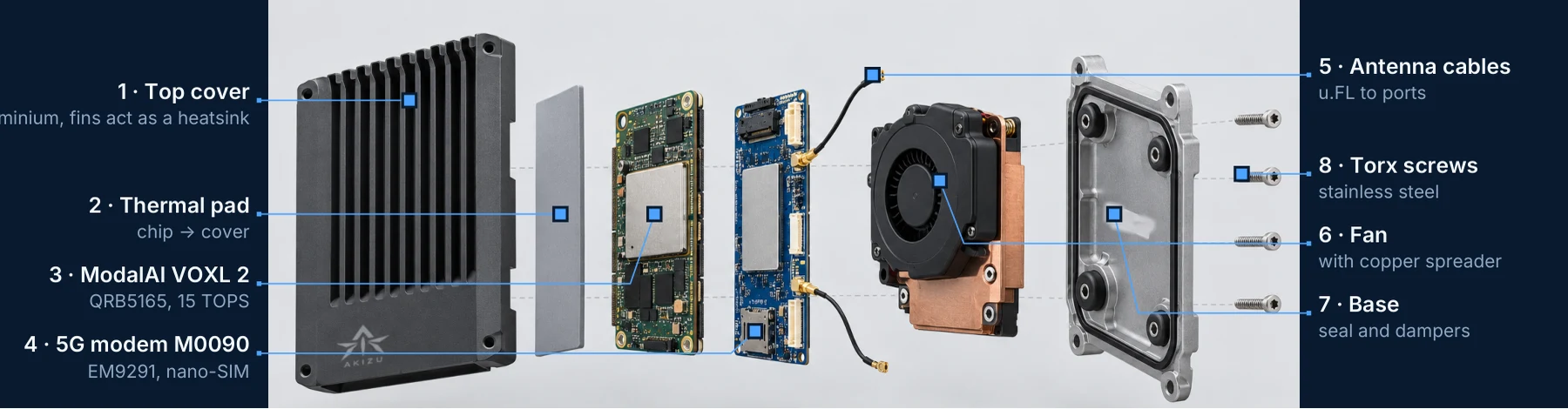
Exploded view of AKIZU Brain: enclosure, VOXL 2, 5G modem, fan, base
Inside Brain: VOXL 2 and 5G modem · visualisation
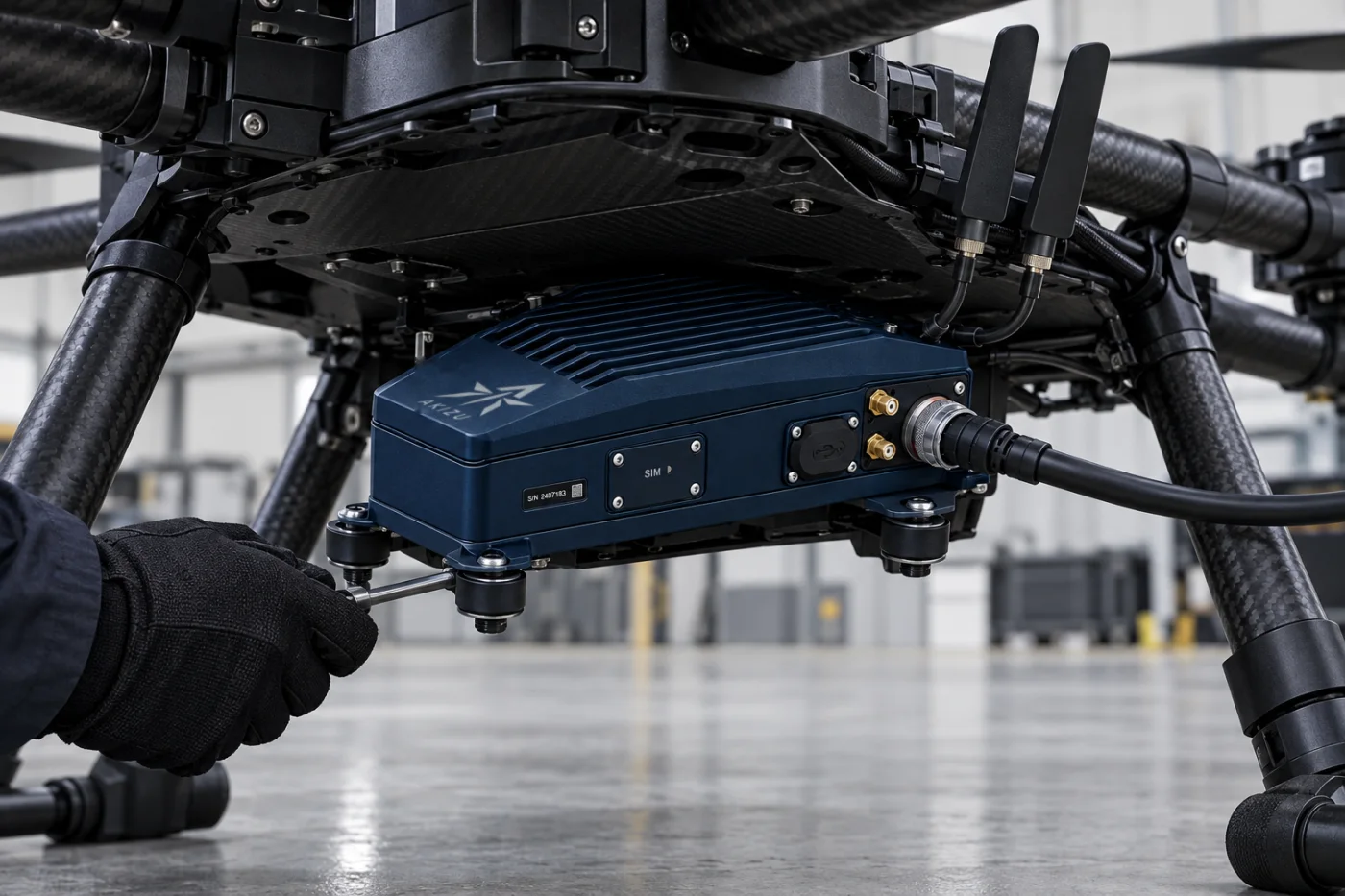
AKIZU Brain mounted beneath a larger drone
Brain on a larger drone · visualisation

Labels and product sheets

All materials
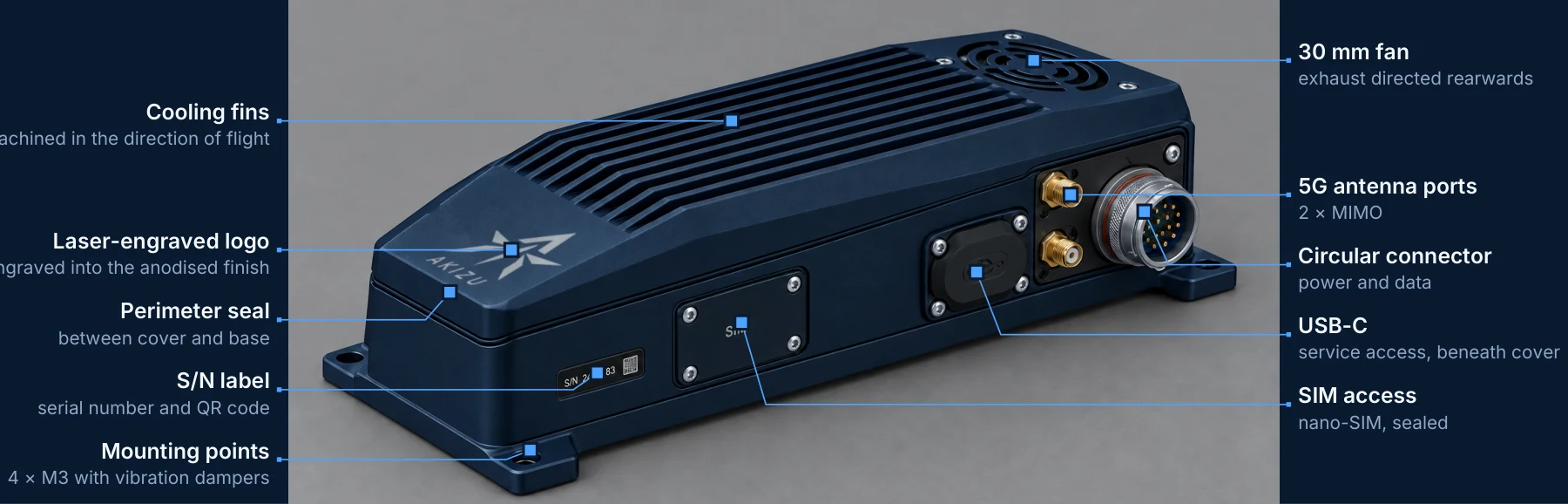
AKIZU Brain labelled: fins, fan, antenna ports, circular connector, USB-C, SIM, mounts
Exploded Brain with labels: enclosure, pad, VOXL 2, M0090 modem, fan, base
AKIZU Drone fuselage detail with labels: GNSS, cameras, service panel, vents

Pre-production visualisations. VOXL 2, modem and Starling 2 Max specifications are stated by manufacturer ModalAI; AKIZU fuselage dimensions, weight and ingress protection are design targets, not yet verified.

04 / Platform

In context.

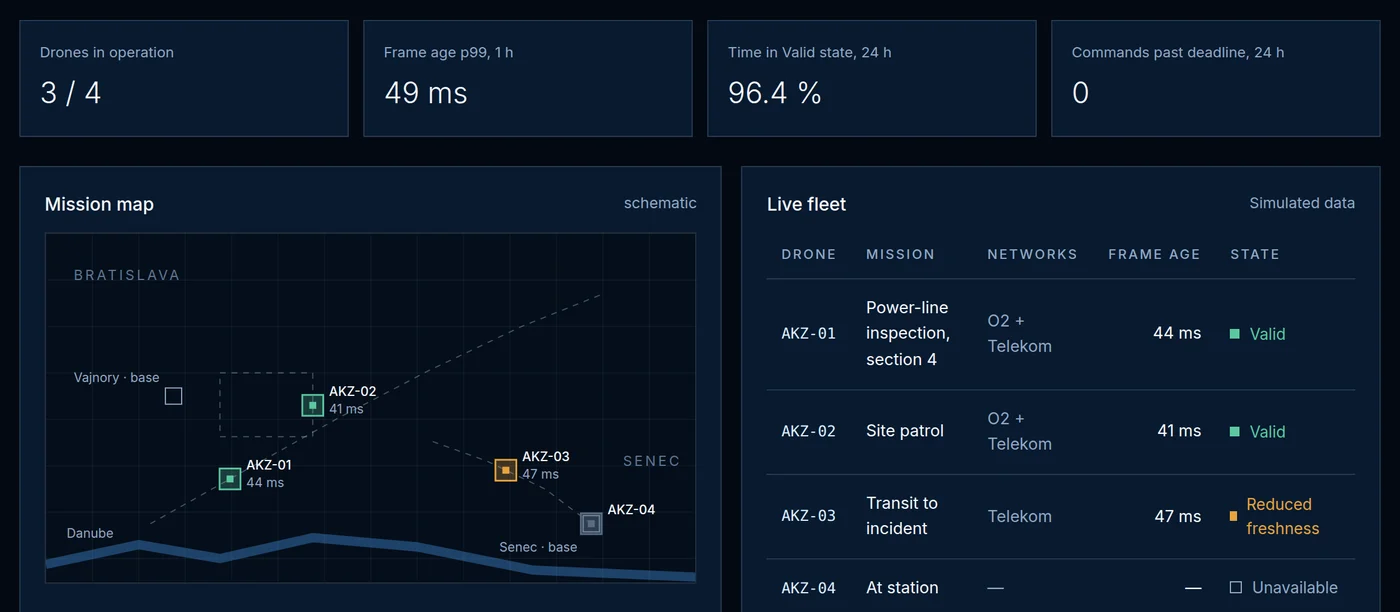
An overview of the fleet, SIM cards and flights in one place. For every flight, the platform stores an evidence pack: what the operator saw, how old it was and what commands they issued.

More about: AKIZU Platform →

Demo workspace / Overview Simulated data
Drones in operation3 / 4
Frame age p9947 ms
Time in Valid state96.4 %
Commands overdue0
Simulated fleet status
DroneMissionNetworksFrame ageStatus

Pilot partners sign in to AKIZU Platform. A demo with simulated data is available without an account.

Interface preview with simulated data. This is not a record of actual operations.

Visualisation / not built for production

05 / Direct

At the controls.

An operator cockpit where time is visible. The panel shows only imagery with a known age. Each command carries the frame number the operator was viewing, and the drone will not execute a late command.

  • FormatDirect Cockpit, desktop, browser
  • Display240 Hz, 480 Hz for research
  • StatusConcept and prototype

More about: AKIZU Direct →

Technology

VERA: imagery with proven age

VERA is our own protocol. Its name comes from the Latin verus, meaning true. When a connection drops, today’s systems leave the last frame on screen, where it still looks live. VERA either proves each frame or rejects it.

Simulation / network status
Camera view in the Direct cockpit · visualisation
Image is not currentReason: connection lost, last valid frame 0 ms ago
Frame age38 ms
Valid
Network
O2 + Telekom · 5G
Frames
60
Data rate
8,2 Mbit/s
Frame age over the last 8 sValid Reduced freshness Unavailable

The video is a visualisation from the Direct cockpit. Network state, frame age and data rate are simulated, not measured.

Valid

Frame age is below the deadline. The operator sees the present.

Reduced freshness

The image is still verified, but its age is increasing. The cockpit shows this and recommends a more cautious flight.

Unavailable

Frame age cannot be guaranteed. A neutral screen with an explanation replaces the frozen frame.

≤ 50 msTarget frame age for first flights (LET-1)Target
64.6 msFull chain today, p50; transmitter is temporarily a phoneMeasured
240Frames per second in the main profileDesign
≤ 2.72 msSwitch to neutral screen after stream lossMeasured

We show the actual status. Each figure is labelled as measured, target or design.

The numbers

Where every millisecond goes

Frame age is the sum of the steps from light on the sensor to light on the display. Choose a profile, network and display. The chart shows where time is spent and whether the system meets the deadline.

Profile
Network
Display
Average frame age27.8 msmin 25.7 · max 29.9 ms
KVAL-1 · 25 ms
LET-1 · 50 ms

    Calculation based on the VERA v1.1 protocol plan. All values are estimates (E); network latency is a working figure for one-way latency. Actual values will be determined by measurement.

    Frame age in metres

    What frame age means in the air

    The operator does not see where the drone is, but where it was. Adjust the speed and frame age.

    20 m/s
    50 ms
    1.0 mdistance the drone travels before the operator sees the frame

    Comparison

    Image latency by manufacturer

    Solutions over mobile networks state 80 to 350 ms. The 3GPP standard allows 140 ms for video beyond line of sight; the VERA target is 50 ms. None of these solutions proves the age of each frame.

    Sources: DJI, Skydio, CubePilot, Sky Drone, DriveU. The dashed row is the 3GPP TS 22.125 requirement for video aiding control beyond visual line of sight, not a product. Manufacturer methodologies vary. DJI O4 uses direct radio, not a mobile network.

    Schematics

    How VERA keeps the image truthful

    Three mechanisms that turn ordinary video into evidence: two networks at once, a deadline for commands, and a header that carries the time.

    01 / Two networks

    Every frame takes two routes. The one that arrives first counts.

    Frames delivered0
    First received via A0
    First received via B0
    Frames lost0
    Image statusValid

    Concept simulation of Brain Duo. Each frame travels via two operators, for example O2 and Telekom. The station displays the first valid copy and discards the second.

    02 / Command loop

    The command carries the number of the frame the operator saw

    30 ms
    Frame age on display31 ms
    Operator response (example)250 ms
    Command path30 ms
    Age of entire loop Aloop311 ms
    Command validity100 ms
    Command will be executed

    The drone knows the exposure time of the frame it generated. It therefore calculates the age of the entire loop using its own clock, without synchronisation. It will not execute an expired command and will continue to hold position.

    03 / 20 B header

    160 bits that carry time

    Every video packet begins with a VERA header. Select a field to see what it does.

    Who it is for

    Where stale imagery is worse than no imagery

    All solutions and the needs filter →

    Why now

    Four changes that favour a proven image

    Standard

    Latency now has a number

    The 3GPP standard allows 140 ms for video aiding control beyond line of sight. The AKIZU LET-1 target is 50 ms.

    Source: 3GPP TS 22.125

    Regulation

    BVLOS flights under SORA 2.5

    EASA introduced SORA 2.5 in September 2025, and several states no longer accept the older version. Operators need evidence.

    Source: EASA, AirHub

    Networks

    Operators offer priority on demand

    Deutsche Telekom and Nokia demonstrated a drone that received temporary network priority at flight altitude.

    Source: Nokia

    Security

    A drone on the network must be identifiable

    The 3GPP standard requires detecting an airborne drone without an aerial subscription. In February 2026 the EU published an action plan on drone security.

    Source: 3GPP, European Commission

    Market

    The markets AKIZU is targeting are growing

    Baseline yearForecast target year

    USD bn. Sources: Mordor Intelligence (software 2026→2031), MarketsandMarkets via GlobeNewswire (BVLOS 2025→2030), UAS Vision (DFR 2026→2033), MarketsandMarkets (drone communications →2030).

    Development status

    What is true today and what comes next

    1. Q4 2026Optical measurementFrame age verified using an independent optical measurement instrument.
    2. Q1 2027LET-1 on VOXL 2Frame age p99 up to 50 ms on a real drone.
    3. Q2 20275G stabilityAt least 95% of the time in VALID state.
    4. Q3 2027First paid pilotDeployment with a partner.
    5. 2028Licences and SIMBrain, SIM and Platform for the first fleets.

    Questions

    Frequently asked questions

    Short answers. We keep measurements, targets and plans apart.

    All questions →

    Is AKIZU a finished product?

    No. AKIZU is in development. Today we have an internal frame-age measurement: median 64.6 ms and p99 87.4 ms over WiFi, with a phone as the transmitter. The hardware shown is a pre-production visualisation.

    How is frame age different from latency?

    Network latency is only part of the path. Frame age is the time from the moment a frame is exposed on the drone to the moment the operator sees it. VERA attaches the exposure time to every frame and the station verifies it before display.

    What happens when the network fails?

    The station never shows an old frame as current. When the age exceeds the limit, it switches to a neutral screen and shows the state clearly. We measured the switch internally at up to 2.72 ms.

    Which drone does it work with?

    The reference configuration is the ModalAI Starling 2 Max with the VOXL 2 computer. AKIZU Brain is designed as a standalone unit that can also be fitted to other drones.

    Which networks will AKIZU use?

    LTE and 5G. The Brain Duo concept sends every frame over two operators at once. The 3GPP standard expects the network to detect an airborne drone without an aerial subscription, so we plan AKIZU SIMs with an aerial profile from the operator.

    Does AKIZU replace a BVLOS authorisation?

    No. Flights beyond visual line of sight need an authorisation in the Specific category based on a SORA 2.5 risk assessment. AKIZU Platform is meant to give the operator a frame-age record as evidence for that assessment.

    How can I get involved?

    We are looking for pilot partners in public safety, inspection and industry, and for measurement partners. Write to info@akizu.com.

    Contact

    See the age of your frame.

    We can demonstrate the system live or measure the frame age on your drone. Get in touch.

    Or write about a specific topic: Pilot project · Frame-age measurement · Investors

    AKIZU · Bratislava, Slovakia