
Two sites
Two states side by side.
Crisis management and civil protection
In a flood or a fire the network is congested and some cells are down. The crisis staff decides on evacuation from the drone image and must know whether it is current.
Needs: Fleet from one centreTwo networks at onceResilience in outages
Illustrative case study
This is not a customer and not a flight that happened. It is a description of how this area would read if the image carried its age.
A crisis staff, an illustration
The staff needs an image of a dike and of another site at the same time. An old frame of the water level must not look live. One cell in the valley is not enough.
In the example every drone has its own state. When the network at one site fails, the staff sees a neutral screen and the reason, not a frozen water level.
After the crisis a record remains of what the staff saw and when. It is not a municipal evacuation plan.
Two states side by side.
A reason, not silence.
What was valid in that minute.
When both networks fail, a radio backup is not yet in the design.
The chart requires JavaScript.
The chart is a simulation. Move the slowdown and see when the example stops being under the 50 ms target. The target is not a measured result.
Deployment schematic
The schematic is not to scale and is not a design for a specific site. It shows where the drone is, which two networks carry the frame and where the decision is made.
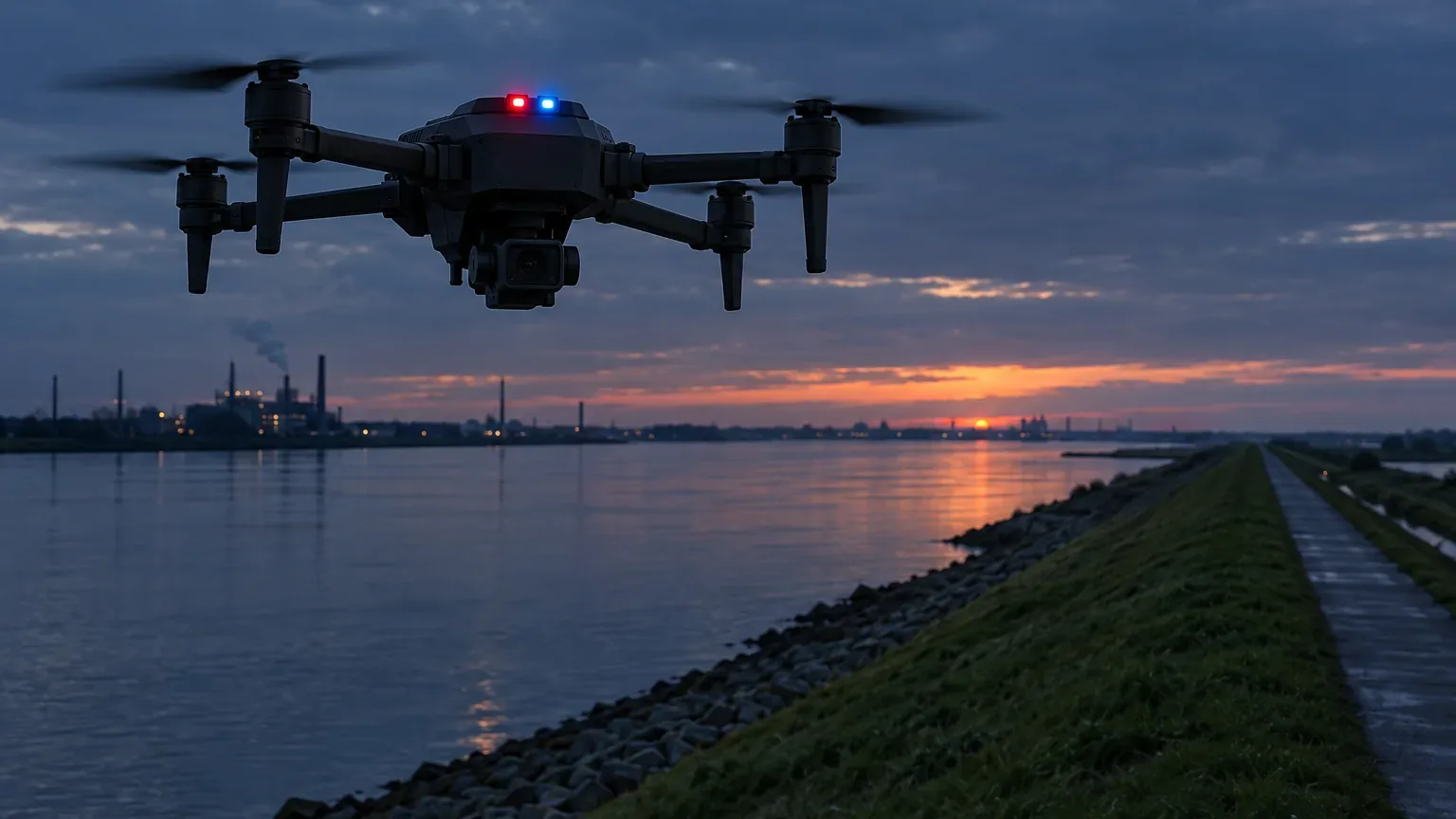
Red and blue beacons: police, state, the military in training. Orange: everyone else. The blink is only on screen. Schematic, design. The list beside it explains the codes in the drawing. The beacon is a payload from another maker, not an AKIZU product.
Concrete case
The same illustrative case as above, written out in time. The times are an example. It is not a record of a flight that happened.
An illustration, not a deployment record. N
Use options
Each row is a separate use. The Parts column says which AKIZU parts it would involve. Status N is a design, C is a target, U is unknown.
| Use | Who uses it | What AKIZU supplies | Parts | Status |
|---|---|---|---|---|
| Floods and dikes | Crisis staff | Two image states side by side | Brain, SIM, Platform, Direct | N |
| A forest fire | Fire service and staff | An image of the edge with its age | Brain, SIM, Direct | N |
| A landslide | Civil protection | A repeat pass and a comparison of days | Brain, Platform | N |
| A staff exercise | Civil protection | A network-loss drill | Direct, Platform | N |
| Both networks failing | — | A radio backup is not yet there | — | U |
None of these uses is deployed today. A row is not an offer and not an authorisation to fly.
01
Many people call at once in the affected area and some masts have no power.
The staff may look at a frame that is no longer valid for a long time and decide on it.
After the crisis you review what the staff knew and when. Without a record that is hard.
A dike and a fire at once. An old frame of one site must not look like a live frame of the other.
The same situation, different information on the screen. Proposed behaviour, to be verified in a pilot.
| Situation | Without AKIZU | With AKIZU |
|---|---|---|
| The image is late | The image looks live; the pilot does not know how old it is. | Frame age is on the screen and the state changes to Reduced freshness. N |
| Several drones, one team | The operator does not know which image is current. | Every drone has its own age and state. An old image is not treated as confirmation. N |
| One network fails | The image freezes or breaks up. | The frame arrives over the second network; the switch is logged. N |
| Link outage | The last frame stays on screen and looks valid. | A neutral screen with the reason, not a frozen image. N |
02
The flow is illustrative. AKIZU is in development.
03
How many metres further the drone is than the image shows. Pick a scenario or set the speed and image age.
The interactive calculation requires JavaScript.
Scenario speeds are examples. 87.4 ms is the p99 measured internally over WiFi with a phone as transmitter, not on a drone.
04
| Requirement | How AKIZU answers it | Status |
|---|---|---|
| Image on a congested network | Two operators at once, first valid copy | N |
| Staff knows what is still valid | Image age and state on every screen | N |
| Justifying decisions | Flight record with image age and events | N |
| Operation with both networks down | A radio backup is not yet part of the design | U |
05
Sees whether the image is current and decides on evacuation.
Gets a clear warning when the image stops being valid.
Gets the record for the review.
06
07
In September 2024, after storm Boris, widespread floods hit Central Europe and rescuers also deployed helicopters.
In February 2026 the European Commission published an action plan on drone and counter-drone security.
Source: European Commission
LTE and 5G. The Brain Duo concept sends every frame through two operators at once. The 3GPP standard expects the network to recognise a drone in the air, so we plan AKIZU SIM cards with an aerial profile at the operator.
The station does not show an old frame as current. When the age exceeds the deadline it switches to a neutral screen and shows the reason. We measured the switch internally within 2.72 ms.
The target is data centres in the European Union. The customer sets the retention period for records and video.
09
The three image states in this area. Proposed behaviour, to be verified in a pilot.
The staff knows the image of the dike or the fire is valid.
An evacuation decision does not rest on an image nearing the deadline without the staff seeing that.
The staff sees that the network failed. They do not see a frozen water level as current.
10
Illustrative layout. Drone and station counts are an example, not an offer.
Dike or fire
Image for the staff, not for a pilot on the spot.
Another site
One staff, several places, each with a state.
Centre
What they saw and when, in the record.
11
Times are an example. They show when image age decides.
12
AKIZU does not replace the staff or an evacuation.
A radio backup is not yet in the design.
An image of known age. The service sends the people.
A pilot in this area
We are looking for first partners. The application is pre-filled for this area.
Other areas
Example deployments are illustrative. AKIZU is in development and does not replace a BVLOS authorisation.
In more detail
Two sites are two states. An old water level must not look live.
One cell in the valley is not enough as an assumption. Bring the places, not a map of the whole country.
When both networks fail, a radio backup is not there yet. That should be said before the exercise, not after it.
Explore
Twelve solution areas and the sections that belong with them. The case studies are illustrations, not completed deployments.